Vintage engagement rings are inspired by ring styles that were popular during different historic periods.Vintage style
engagement rings are characterized by beautiful and intricate filigree work. Browse through our collection and find a Vintage looking ring that will cherish forever.
Alternatively, send us your pictures we will custom make your engagement ring, free of charge.
The timeline of Vintage Engagement rings:
Georgian Engagement rings & Jewelry, 1714 to1837
The Georgian Era spanned through nearly a century and a half starting approximately from 1714 and ending in 1837. It was an era marked with opulence and prosperity, under the monarchy of King George I of England and his successors II and III. To these relegated leaders, the era owes its name and staggering economic growth. The flourish reflected in the jewelries of the era. A number of momentous historical events unfolded in this time, the American Revolution and the French Revolution being two prominent ones.
But in jewelries, the England of Georgian Era bore no signs of the political strife and turmoil. In fact, the closest thing imaginable to the Georgian jewelries is England in the words of Jane Austen. Long-standing courtships, rich refineries and such was the essence of the jewelries of this era. Georgian jewelries as we know it today were fashioned in a number of styles from Gothic to Neoclassical and more. Very rare in today’s century, Georgian jewelries is one of the most precious vintage jewelries in existence.
Diamonds were a dominant choice of gemstone at first, but colored gems took precedence later. Old mine and rose cut diamonds frequently appeared in the jewelries. In colored gems, sapphires, emerald and rubies held sway.
A significant feature of the Georgian jewelries is the closed back setting in which the back of the gemstone mount is enclosed to hide the entire pavilion.
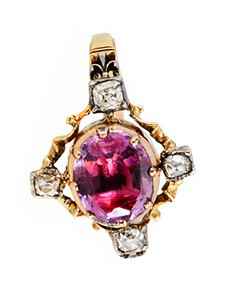
Georgian era Vintage Engagement ring
Victorian Engagement rings & Jewelry, 1837 to 1901
From 1837 to 1901 is historically the era of Queen Victoria, popularly named the Victorian era. Queen Victoria’s reign over England continued for 6 decades during which jewelries were highly endorsed among other things. Fine jewelries became the mark of aristocrats under Queen Victoria. It is also during the same era that expensive baubles started to become accessible to the burgeoning middle class people of Europe and across the pond in the States.
Queen Victoria had a great taste in jewelry and that reflected in the pieces styled during this era. Jewelries from this period of time are exquisite and tasteful, to say the least. The pieces mimicked the romance between Queen Victoria and Prince Albert. Hearts, flowers, bows and birds were the dominant motifs of the time. Enameled serpents, stars, dragons, crescent moon and griffins were common too. Gold and diamonds were on the rise.
But towards the later part after the tragic demise of Prince Albert, the art assumed a melancholic spirit, in that, fossilized coal jewelry studded with black onyx and detailed with black enamel rose to popularity. Between filigree, engravings, Japanese influence and dark motifs, jewelry in Victorian Era mirrored the life of the time.
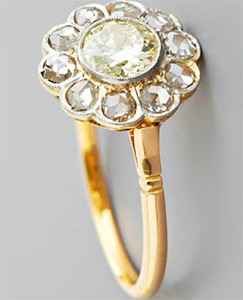
Victorian era engagement ring
Art Nouveau Vintage engagement rings & Jewelry
The era between 1890 and 1910 was popular for art, and was therefore fittingly named Art Nouveau, literally meaning New Art. The very brie era shared parts of its timeline with the Edwardian and Victorian periods and was characterized by a remarkable flourish in arts. Jewelry art in Art Nouveau was original and vibrant from the European art influences. The jewelries of this epoch reflected the artistic movement that took place then. The jewelry makers of this time took the art to a new level. Considering themselves as artists than craftsmen, they produced some breathtaking pieces of jewelry that are admired to this day.
Aside art, the artists also turned to philosophy to find inspirations for the art. That explains the overall mystical mood of the jewelries crafted in this short-lived era.
The mood of jewelries of this time was soft, melodious and romantic. Waves and curves, flowing lines and soft colors characterized the jewelries of this time, something that was borrowed by the Edwardian and Victorian jewelers. Being influenced by Japanese art, the artists used motifs like lilies, orchids, feminine forms, ferns, irises, dragonflies, butterflies and serpents.
Diamonds were rare, whereas colored gems like Moonstone, Opal, Amethyst, Amber, Citrine, freshwater pearls and Peridot were abundant.
Uncommon materials like shell, copper and horn were used as well.
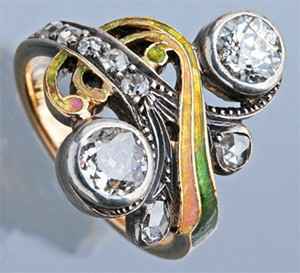
Art Nouveau Engagement ring
Edwardian era engagement rings & Jewelry, 1901 to 1920
Jewelries from the Edwardian era are best described as elegant and graceful. They are lightweight, ornamented with fine filigree patterns and bears ample threads of platinum, gold and other metals in the designs.
Historically, the Edwardian era extends from 1901 to 1920, which is almost as short as the preceding Art Nouveau period. Named after the then king of England, King Edward of Britain, the period is known for its confluence of new and old. It was a time when the Victorian culture hadn’t complete faded, but new trends were setting in. Jewelries in this transitory era were elaborate, and bore a superb lacy look, something that was purposely put together to complete a woman’s ensemble. The jewels from this period were handcrafted to complement lace dresses and feathered hats.
Still deeply influenced by the Victorian era, the jewelries expressed femininity social decorum. The jewelry makers focus was adjusted on classic palettes and motifs that were simple, but elegant. Gems were abundantly used in jewelries in that time. Roman, Green, French Baroque and Napoleonic influences were bold in the jewelry styles. Some motifs that were commonly sighted in the Edwardian baubles were bows, tassels, scrolls, floral garlands and laurel wreaths. The illustrious motifs are reflective of the energetic sensibility of the period.
The key components of the jewelries of this period were platinum in metals, and pearls and diamonds. The signature Edwardian rings were carved in platinum and adorned with diamonds and pearls. It is the use of platinum that made the jewelries light weight and durable. With diamonds and pearls being the prominent components of highlight, the Edwardian jewelries often wore an excess of white.
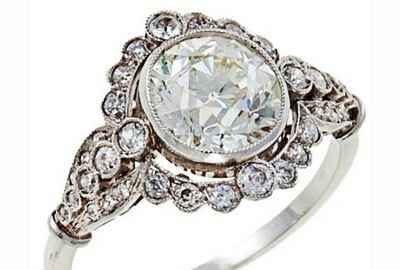
Edwardian Era Engagement ring
Art Deco Vintage engagement rings & Jewelry 1920 to 1935
Between 1920 and 1935 is a decade that is recognized in the history as the Art Deco era. The art of jewelry making took a flight towards modernism from this point. As a result, the jewelries that were passed on to us from the Art Deco period had a generally fun and stylish mood. The Art Deco baubles are characterized by striking geometric patterns and bright colors that make them visually interesting. The free-thinking spirit of the roaring 20s cast a reflection on the confident expressions of the jewelry artists of this time.
This era witnessed the passage from the Victorian conservatism to a modern liberalism. Between the rise of gangsters, emergence of flappers and opening of speakeasies, the economy boomed and the previously obscure jazz music took off. A general willingness in people to cast aside the Victorian propriety and embracing a more open and freewheeling life made an impact on the design inspirations of the artists.
Jewelry in Art Deco became more about expressing one’s individuality in matters of fashion, opinion, principle and taste. A bold and sharp style came out of this mental undertone. The lacy filigrees of the Edwardian past took a back seat while the mellow shades and sways of Art Nouveau assumed a brighter more shocking mood. Along came jewelries crafted with net straight lines and a pop of colors.
The futuristic motif of the Art Deco jewelries were indicators of a confident and open-minded people. Diamonds took a front seat while platinum became the prominent jewelry metal. A number of intricate settings too were rolled out by the jewelry makers of this time.
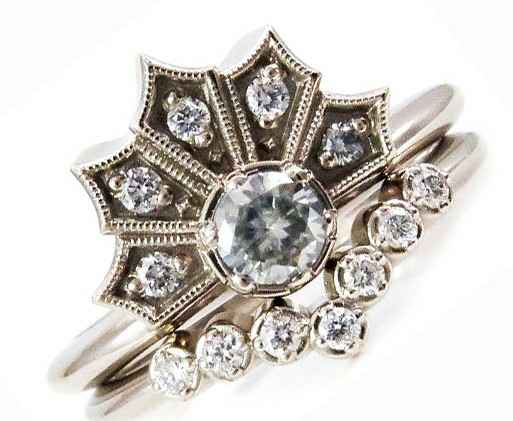
Art Deco Era Engagement and wedding rings
Read even more on the time line of Vintage engagement rings in Wikipedia


 ​
​